

Science
Curricular Goal
A Community of Science Inquirers
Keming Primary adopts an inquiry-based approach to learning science. This investigative approach to learning requires students to investigate a problem, search for possible solutions, make observations, ask questions, test out ideas, and think critically to make a final decision.
Inquiry-based learning allows students to explore, develop explanations for the phenomena under investigation, elaborate on concepts and processes, and evaluate their understanding considering available evidence. Scientific knowledge, scientific inquiry and scientific skills are emphasised in classroom teaching to achieve the 21st CC as desired outcome in our curriculum.

Every Child A Seed
National Environment Agency provides each Primary 3 student with a pot of soil with different type of seeds, mainly roselle, kangkong and sunflower. The students grow these seeds under the guidance of their Science subject teachers. Through this activity, the students learn about the basic needs of plants and how to care for plants. They also observe and study the life cycle of these plants. Students are proud that their seeds manage to germinate and blossom under their care.

Leadership Training for Science Monitors
Our Primary 4 Science Monitors take on a meaningful role as peer educators, trained by Zoo Educators at River Wonders. Armed with knowledge about the fascinating organisms that call the river ecosystem home, they return to school ready to share what they have learnt.
Each Primay 4 Science Monitor is paired with two to three Primary 3 students, guiding them through how river organisms survive and why it is important to protect these species from extinction. This experience goes beyond Science — it builds confidence, nurtures leadership, and develops the ability to communicate ideas clearly to others.

Our Primary 5 Science Monitors visited the Science Centre for Brain Fest, an engaging programme designed to develop leadership skills and deepen their love for learning. Through hands-on activities and interactive experiences, students were challenged to think critically, work collaboratively, and step up as leaders.

SCIENCE E2K Programme
The E2K Science programme offers our students an exciting opportunity to explore advanced scientific concepts beyond the classroom curriculum. Designed to stretch curious and capable young minds, the programme develops students' process skills and critical thinking as they investigate real scientific questions.
Working in teams, students collaborate to understand tasks, collect data, and draw conclusions — learning not just the science, but how to think and work like scientists. Through discussion and exchange of ideas, they sharpen their ability to communicate their thinking clearly and confidently.
At Keming Primary, we believe that great scientists are not just knowledgeable — they are curious, creative, and collaborative. Through E2K Science, we hope to nurture Kemingnites who approach challenges with an inquiring mind, communicate with confidence, and develop a lifelong love for discovery.

Garden Trail
The Eco Garden has been created to enable students to have a good experience in understanding the different types of garden plants and how these plants could grow and adapt to live in the ecosystem.
Students learn about the plants and plant parts that are found around the school compound. They follow the trail mapped out on ipads and make use of several apps to make scientific observations about the flora in the garden. Through this engaging activity, students learn the value of harmony as they work in groups to complete the various tasks assigned to them.
Students gain relevant knowledge and skills and make sense of the new experience with their peers.
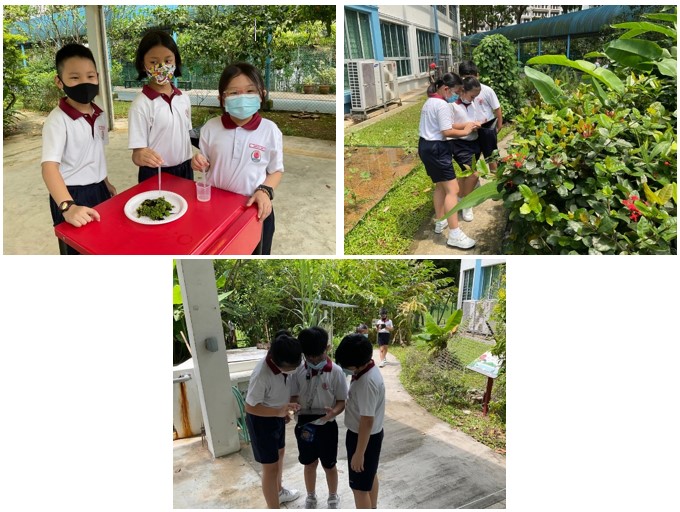
Students walking in the Science Ecogarden to learn about the diversity of living things.
I.G.N.I.T.E. Lessons
(Inspiring Growth N Inquiry Through Exploration)
I.G.N.I.T.E. lessons allow students to put their science concepts learnt into practice. Students get to build and create parachutes, towers and wind-powered cars and through trials and modifications, come up with the best model for their final presentation.
In order to design the best parachute that can stay in the air for the longest time, the Primary 3 students need to find out which type of materials will be best for the canopy and how wind and other factors can affect the time the parachute can stay afloat.

Primary 4 students take on the challenge of building a bridge using sticks. They need to understand how to assemble the sticks to ensure the sturdiness of the bridge, so that it is well-supported at the base and will not collapse.

Primary 5 students create a wind-powered car using recycled cardboard materials. They can remodel the car after fixing the parts to test on the furthest distance that the car can move after their modifications.
Robotic hand made by students.
